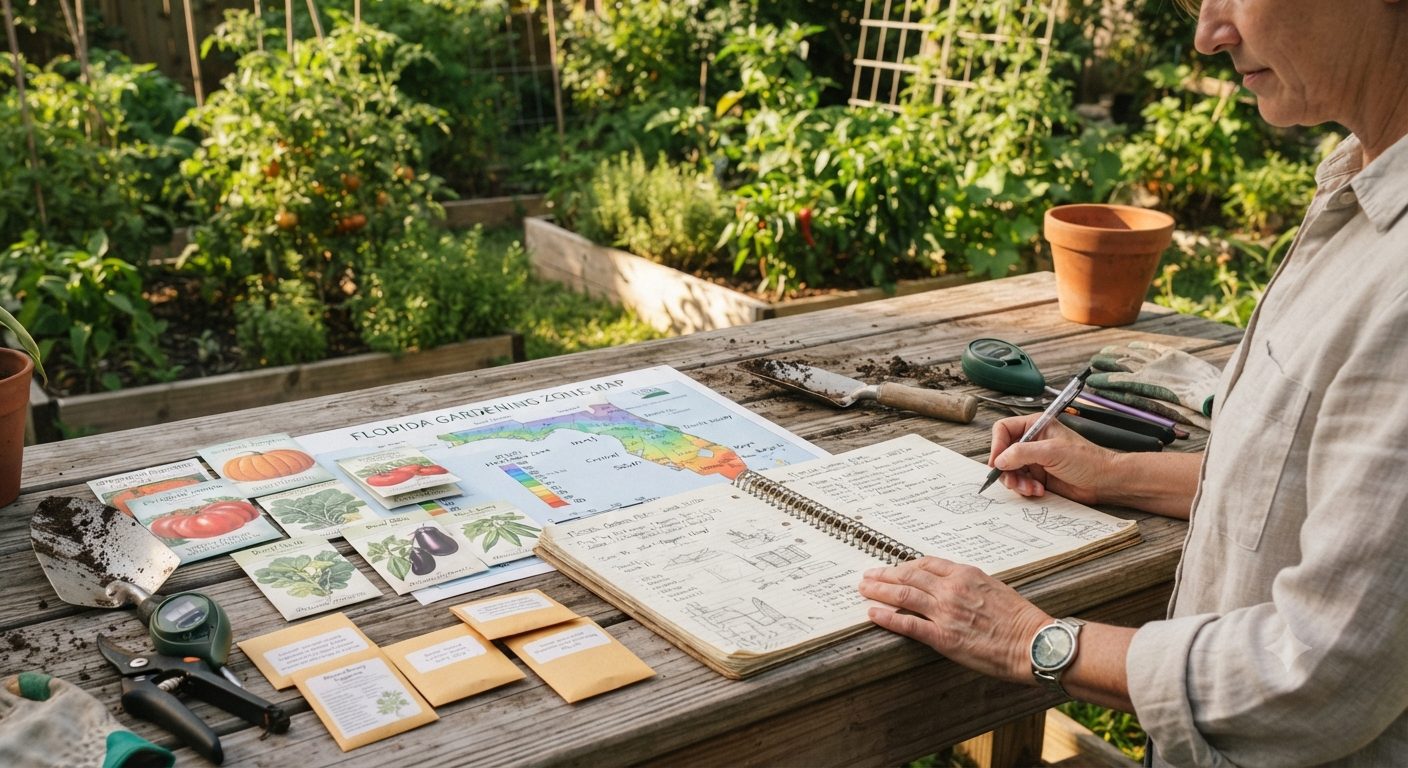
Florida planting zones help gardeners understand which perennial plants are likely to survive winter temperatures in their area. The USDA Plant Hardiness Zone Map is based on average annual extreme minimum winter temperatures, and gardeners use it to estimate cold hardiness.
But planting zones do not tell the whole story. In Florida, gardeners also need to consider heat, humidity, soil type, rainfall, salt exposure, pest pressure, and local microclimates.
What USDA Zones Actually Tell You
USDA zones are most useful for answering this question: "Can this plant survive the coldest winter temperatures in my area?"
That matters for fruit trees, landscape plants, perennials, herbs, tropicals, and long-lived food forest plants.
For example, a plant that survives in Zone 9b may not survive a colder Zone 8b winter without protection. The USDA map is the national standard for estimating perennial plant cold hardiness, and it's built from 30 years of weather station data (currently 1991–2020).
What USDA Zones Do Not Tell You
USDA zones do not tell you:
- When to plant tomatoes
- Whether your soil drains too fast
- Whether summer heat will stop fruit set
- Whether your yard has frost pockets
- Whether your garden gets salt spray
- Whether a plant can handle Florida humidity
That is why Florida gardeners need both zone information and local gardening guidance. UF/IFAS Gardening Solutions notes that Florida has varied growing conditions across the state, and that some plants grow easily statewide while others need much more specific conditions.
Florida Has Regional Growing Differences
Florida is long from north to south, and conditions vary dramatically. North Florida has more winter chill and more freeze risk. South Florida has a more tropical growing pattern. Central Florida sits between those extremes.
UF/IFAS provides separate gardening calendar guidance for North, Central, and South Florida because planting timing varies so much by region.
That means a Zone 9b gardener in Central Florida may have different timing than someone in coastal South Florida or inland North Florida.
Microclimates Matter
A microclimate is a small area that behaves differently from the surrounding region. Examples include:
- A warm wall that protects tropical plants
- A low spot where cold air settles
- A windy coastal yard
- A shaded oak canopy
- A paved driveway that radiates heat
- A raised bed that drains faster than native soil
Microclimates explain why one gardener can grow a marginal plant successfully while another gardener nearby loses the same plant in a freeze.
Coastal Conditions Add Another Layer
More than three-quarters of Florida's population lives in coastal counties, and salt spray can be a major factor for gardens near the coast — UF/IFAS Florida-Friendly Landscaping guidance recommends salt-tolerant plant selections for yards within about an eighth of a mile of open water.
So even if two gardens share the same USDA zone, one may need very different plant choices because of salt exposure.
Common Mistakes
The biggest mistake is treating USDA zones like complete gardening instructions. They are useful, but they are only one layer of decision-making. Gardeners should combine USDA zone, Florida region, local frost history, soil type, sun exposure, drainage, and microclimates.
What To Do Today
Look up your USDA zone, then identify whether you are gardening in North, Central, or South Florida. After that, start tracking your own yard's microclimates. Notice where frost hits first, where soil stays wet, where afternoon sun is strongest, and where plants seem happiest.
Built around zone AND region
Our Zone 9b Planting Calendar includes variety-specific timing instead of generic zone advice — built around the same zone-and-region layer UF/IFAS recommends.
Shop on Etsy →Want reminders sent to you as the seasons shift? Subscribe to the free newsletter.